
Lodi Previous Residents: Era by Era
A house-history search works best when each source has a time span and a claim. San Joaquin County Recorder-County Clerk advertises 168 document types back to 1851. The portal is an online first stop; the Stockton counter, phone, mail or copy route, and museum holdings cover harder records. A deed names parties and a legal description, not who slept at an address.
The Recorder-County Clerk information page places Lodi title research in San Joaquin County.
The remaining sources add household, map, civic, and estate layers.
| Source | Years It Covers | Where Held | What It Shows |
|---|---|---|---|
| Recorder instruments | 1851-present | San Joaquin County Recorder-County Clerk | 168 document types, parties, dates, legal descriptions |
| Museum directories | 1852-1980 | Historical Museum at Micke Grove, Lodi | Listed adults, address order, local names |
| Federal census | 1850-1950 public schedules | NARA, FamilySearch, and library databases | Households, relationships, enumeration districts |
| Museum maps and aerials | 1860-1990 | Historical Museum reference library | Roads, parcels, buildings, and street labels |
| Lodi city records | 1907-1962 | Museum collection and OAC finding aid | Public works, minutes, and property projects |
| GIS and Assessor | Current | Lodi GIS and San Joaquin County | APN, parcel shape, assessment, and mailing lead |
| Court probate | Current portal plus request or archive | San Joaquin Superior Court | Petitions, heirs, orders, and property disposition |
Lodi's span is not a full annual run. Museum materials are countywide, and a Lodi address may sit in incorporated Lodi, postal Lodi, Woodbridge, or rural county land. A Lodi household may appear in an assessment book before a directory. Keep the layers separate.
Note: A collection span does not prove annual Lodi editions.
Lodi Previous Residents: Start with the Parcel
Start with a current address, then turn it into a durable parcel key. In the Lodi GIS Property Viewer guide, choose “Find Address,” enter the street number and name, select the result, and open Layers. Save the situs address, parcel outline, APN, and cross streets. An APN is the assessor's parcel number, useful when a road or number changes.
Compare the Lodi map with Assessor information. The county Assessor maintains ownership, values, parcel traits, maps, and mailing address. The county Tax Collector search uses a fee parcel number but provides no owner information online and warns that an unsecured bill may not be owed by the real-property owner. For owner-name research, use Suite 230 at 44 N. San Joaquin St., Stockton, or call 209-468-2630 on weekdays.
Trace Lodi Deed Records to Previous Residents
The Lodi deed index is a party and document index, not a street-browse list. Search the current owner or grantee, then inspect the instrument with the matching legal description. Fields may include name, document number, type, date, and book or page. With 168 types back to 1851, the trail reaches beyond a parcel screen, although early books may need counter help.
The County Recorder records and services page identifies the office behind the recorded-document search used for a Lodi address.
The image reflects the custodian's role. Each deed still needs a legal-description match.
- Keep the current situs address, APN, and legal description together.
- Find the purchase deed by searching the owner as grantee. Record the instrument number, date, type, book, page, and parties.
- Read the grantor as seller and grantee as buyer. Use the prior seller as the next grantee search key.
- Repeat while matching the same lot, block, subdivision, or metes-and-bounds description. Constrain common names by date and type.
- When the online trail stops, take the document or book and page reference to the Stockton counter or ask about copies and mail.
- Grantor and grantee
- The grantor transfers an interest; the grantee receives it.
- Chain of title
- A sequence of transfers from a present title interest to earlier parties.
- Legal description
- Lot, block, subdivision, or metes-and-bounds wording that outlasts a street number.
- Criss-cross directory
- An address-ordered directory moving from location to a listed adult.
- Enumeration district
- The census area assigned to an enumerator when an address is unclear.
Lodi Address Records: Three Identities
Lodi parcel records can carry three address clues. Situs is the physical property label. Mailing address is where tax or assessment correspondence goes. Legal description is the deed's durable lot, block, subdivision, or metes-and-bounds wording. A previous-resident trail fails when these fields are treated as one. Keep them side by side.
| Record clue | What it helps answer | What it cannot prove |
|---|---|---|
| Situs address | Where a parcel or building is physically labeled | That the current label existed in an older source |
| Tax mailing address | Where assessment or tax correspondence was sent | That the addressee lived at the parcel |
| Legal description | Whether deeds and maps refer to the same land | That a named title party occupied it |
| APN or fee parcel | Which assessment key connects a map to a roll | That every household member appears in the roll |
A deed can name a trust or other entity. A tax mailing address can point away from Lodi. A directory can list a household that does not hold title. Keep owner, assessee, mailing addressee, and listed adult separate. That prevents a deed chain from becoming a complete residents directory.
Lodi Records Across Changing Addresses
Lodi's early records use more than one place label. The railroad settlement was called Mokelumne in 1869, changed to Lodi in 1874, and incorporated in 1906. Search both names for early deeds, directories, maps, and civic records. Postal Lodi can extend beyond incorporated boundaries, while Woodbridge is a separate nearby community.
The official Lodi history chronology helps date the name changes and the 1887 Sacramento Street fire.
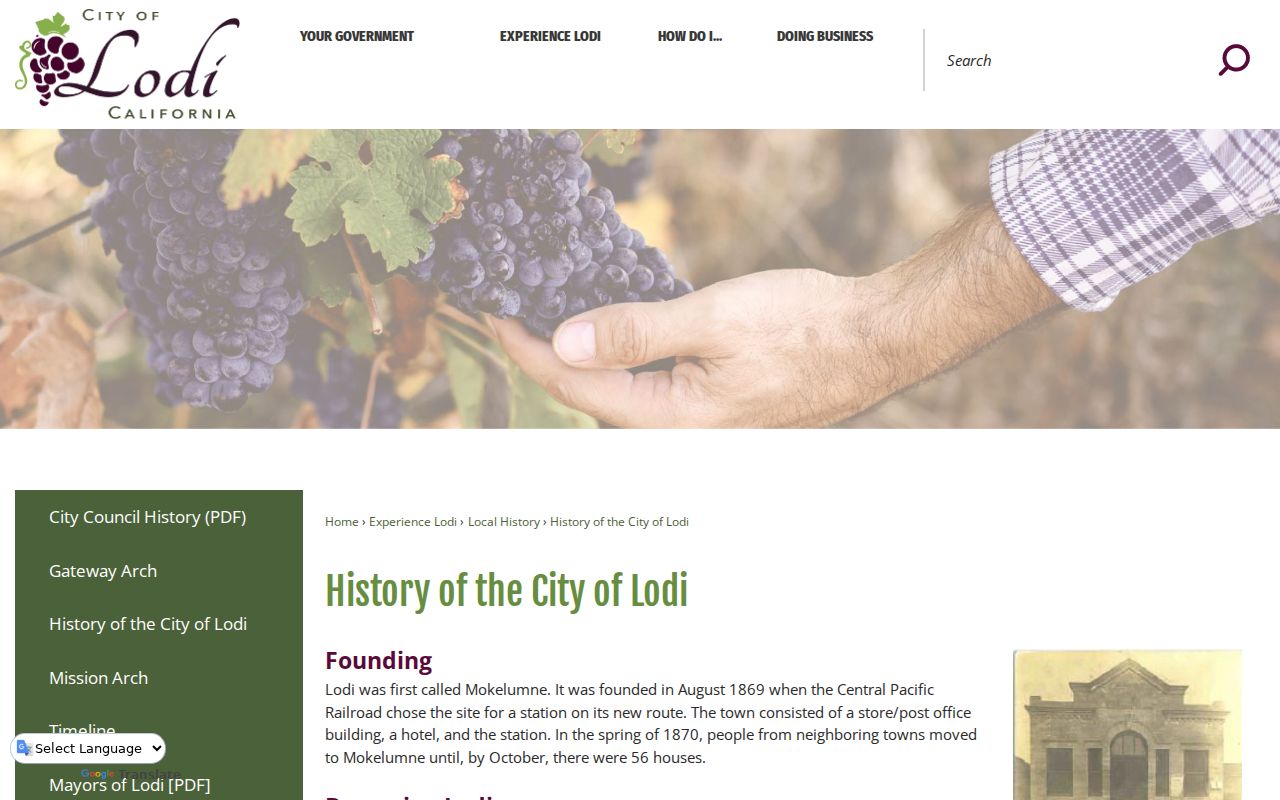
The 1887 downtown fire destroyed the commercial core. It did not mean county deeds in Stockton were lost, but rebuilt structures and address evidence can break. No verified official source located a citywide numbered-address renumbering year. Compare Sanborn sheets, maps, aerials, plats, cross streets, and legal descriptions.
Rural routes and ranch names may predate modern numbers. A subdivision may first appear in an aerial, plat, or building file. Test rural-route, unincorporated, Woodbridge, and spelling variants before calling an address vacant.
Lodi Previous Residents in Directories and Census
Lodi's household layer begins where title ends. Lodi's Historical Museum city and county directories span 1852-1980, but that is not proof of an annual Lodi volume. A known 1950 Stockton & Lodi example has a Lodi section. Read it, not a same-name Stockton entry. Alphabetical pages move name to address; street pages move address to a listed adult.
Lodi Public Library staff can identify directory and telephone-book years, microfilmed newspapers, yearbooks, obituaries, and genealogy databases. Lodi library is at 201 W. Locust St., 209-333-5566, with posted hours Monday-Wednesday 10-6, Thursday noon-8, Friday closed, Saturday 10-5, and Sunday 10-2. Verify before travel. The Lodi city directory collections page carries shelf context.
- Choose the directory nearest the census year and record the name, spouse or widow notation, address, page, and key.
- Check the street section and nearby names, then repeat in prior and next editions.
- Pair directory years with the 1900, 1910, 1920, 1930, 1940, and 1950 schedules. Record the enumeration district and surname variants.
- If a name is absent, test a rural route, no telephone listing, move, missed canvass, nonpublication, or catalog gap.
- Compare the directory address with deed and assessment dates, keeping a listed adult separate from a title party.
Federal schedules are public through 1950 under the 72-year rule; the 1960 release is due in 2032. Before 1900, address detail may be weak, so districts, land records, and directories must work together.
Lodi Previous Residents: The 1890 Gap
The 1890 population schedules were largely destroyed nationally. For a Lodi house, use Great Registers, assessment books, plat books, newspapers, obituaries, and the First Families of San Joaquin/Pioneer Registry. Great Registers identify eligible voters and locality, not every person on a block. Pair an entry with a deed, directory, or map before treating it as the same household.
When a deed names a winery, farm, company, or entity, use California's business search to separate an entity, filing, and address association. It supports entity number and Keyword, Exact, or Begins With modes, with abstracts and imaged Statements of Information when available. An agent or business address is not proof of residence.
The California Secretary of State business-search tips show the separate entity-search path that can clarify a name in a deed or filing.
That distinction keeps a former-resident trail from merging a company record with a household record.
Lodi Previous Residents: City Records
The Lodi city-records collection runs 1907-1962, with bulk 1907-1943. Its OAC finding aid for Lodi City Records describes minutes, ordinances, property projects, and correspondence. It is not a resident roll, but it can explain a new structure, street work, or public improvement. Ask for a box or folder instead of treating the description as a digital file.
A Lodi permit or code file may identify an applicant, contractor, owner representative, project, parcel, and dates. Request it through Lodi's public-records channel when it is not exposed in the viewer. Name the address or APN, department, date range, and project. A permit applicant is not a former resident without another source.
Lodi Previous Residents: Obituary and Probate Endpoints
A former resident may disappear because of a move, death, name change, or skipped address. Lodi newspaper files, funeral-home obituary archives, and vital-record channels can supply a date or family link. Treat an obituary as a lead. Verify it against a death record, probate petition, or later deed. Search surname variants, initials, married and birth names, and the parcel tied to the notice.
For Lodi estates, start with the San Joaquin Superior Court FullCourt public case portal when a case is online. Lodi court's Records Management workflow supplies kiosk, online request, mail, copy, and appointment routes. A Lodi probate docket can identify a petition, heir, order, or property disposition, but not that every heir lived at the address. Use the Lodi Branch or Stockton staff when the portal does not expose the file.
Note: Probate can explain a title transfer, while an obituary can supply a family clue; neither is a complete address roster.
Lodi Previous Residents: What Records Cannot Prove
Title is not occupancy. A directory is not a complete household. GIS shows geography; Great Registers omit nonvoters; Safe at Home can substitute a protected address. Utility, library, and DMV data are not public resident lists. Keep source, date, and claim beside each name.
Previous-resident research suits house history, genealogy, estate work, and personal curiosity. Do not use a deed, directory, map, obituary, or court file to watch or pressure a living person. California's anti-stalking rule keeps the purpose narrow.
Lawful personal use. Lodi address research may support house history, family history, and a lawful records question. Using records to stalk, harass, intimidate, or harm anyone is prohibited and can be criminal under California law.