
What a Lodi Resident Lookup Can Confirm
One person's record trail is split among different keepers. A Lodi resident lookup may begin with a name, but each source answers a different question. The San Joaquin County Assessor ties an owner or assessee to a parcel and a tax mailing lead; it does not show who occupies the property. The Recorder index names parties to deeds and other instruments. Court records show party roles and events. Vital records confirm an event when access rules allow. State business, license, and unclaimed-property searches add affiliations or older city clues. A directory or census entry can place a household in a past year. Cross-check two independent custodians before treating a match as the same person.
| Record | What It Confirms | Where to Search | Access |
|---|---|---|---|
| Assessor roll | Ownership or assessee, parcel, and a tax mailing lead | San Joaquin Assessor | Office or data request; not an occupancy roster |
| Recorder index | Named title and secured-document parties | County self-service portal | Index and copies; research reaches back to 1851 |
| Voter status or file | Own registration, or restricted voter details for an approved purpose | California status service or county request | Self-only online; full data is controlled |
| Court docket | Party role, case number, events, and name variants | San Joaquin FullCourt and Records Management | Remote limits, kiosk, mail, and copy fees |
| Vital record | Event identity and qualifying relationships | County Recorder, County Clerk, or CDPH | Informational and authorized rules apply |
| Business filing | Entity affiliation, agent, and address at filing | California Secretary of State | Free abstract; filings may be stale |
| Professional license | License status, discipline links, and address of record | California DCA or a board | Free public status fields |
| Unclaimed property | Name plus an older city or ZIP association | California Controller | Free clue; not present residency proof |
| Directory or census | Historical listed address and household context | Museum, library, or federal schedules | Year and edition limits apply |
Choose the first source by what is already known. An address points toward the parcel and Recorder chain. A case concern points toward FullCourt and the court's copy process. A family question points toward vital records, directories, obituaries, or probate. A business clue points toward the Secretary of State or a licensing board. A second source should add a different fact, such as a date, role, parcel, spouse, or entity, rather than repeat the same name.
Note: An owner, an occupant, a mailing addressee, and an agent can be four different people.
Lodi Court Records for a Resident Lookup
San Joaquin Superior Court's FullCourt Enterprise Public Access Portal supports public case and calendar searching. Case number mode is the most precise. Party mode can use a last name and an optional first name, while case type and filing-date ranges can narrow a result when those controls are exposed. The portal warns that it is not the official record. A docket is the court's running case history. It can show parties, filings, events, hearings, and register-of-actions entries without providing every document image. Confidential and limited categories may not appear through remote access.
| FullCourt field | Type | Use |
|---|---|---|
| Case Number | Text | Most precise mode; preserve prefixes and hyphens |
| Party or Last Name | Text | Name mode; try spelling and surname variants |
| First Name | Optional text | Narrows a common surname when offered |
| Case Type | Optional selection | Civil, probate, family, criminal, or traffic where remotely exposed |
| Filing Date or Range | Optional dates | Separates same-name parties across time |
A useful result is a lead, not a final identity match. Read the court location, case number, type, filing date, and party role together. A plaintiff, respondent, petitioner, grantee, agent, or licensee may share a name with the person being sought. The result may also omit protected family details, juvenile or adoption material, victim information, and sealed documents.
- Court or branch location and the case number, including its prefix and hyphens.
- Case type and status, such as civil, probate, family, criminal, or traffic where remotely exposed.
- Filing date and later register-of-actions events.
- Party names, roles, and visible name variants.
- Hearings or calendar entries, when the public result includes them.
- A warning that a document image or the official record is not guaranteed.
The Superior Court Records Management page lays out the access routes behind a public case result.
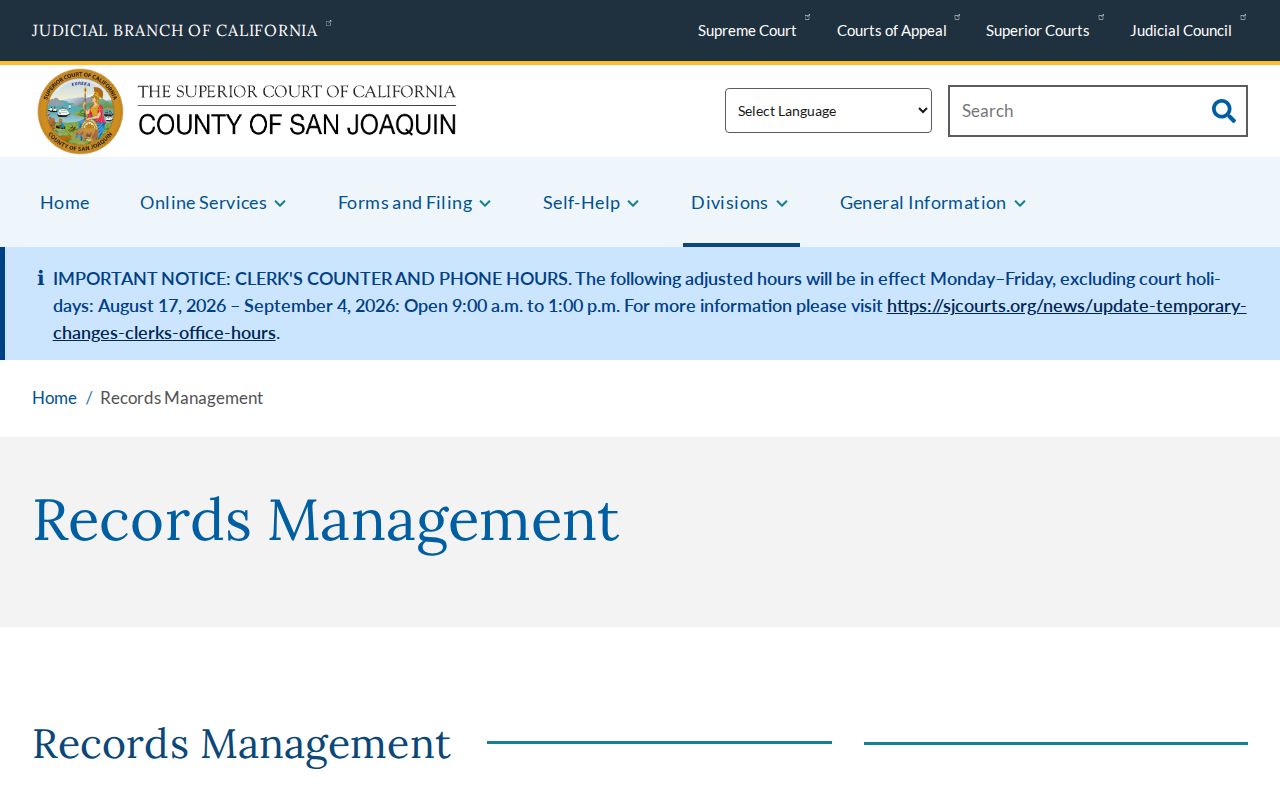
The court access screen makes the key distinction clear: a name search can identify a file, while a copy request supplies the document that can be checked and cited.
Lodi's Older Criminal Records Need Counter Access
FullCourt's digital notice matters for any Lodi resident lookup involving an older criminal case. Criminal Registers of Actions before October 19, 2015, plus information withheld under California Rule of Court 2.507, must be viewed onsite or ordered. The Lodi Branch is at 315 W. Elm St., Lodi 95240. Research and name-search terminals are listed at Stockton Main, 180 E. Weber Ave., on the second floor. A researcher can walk in or arrange a view-room appointment. That fallback is part of the search plan, not evidence that a name has no court history.
For a copy, Records Management's online request needs a case number and valid email. Staff state that they contact the requester within 24 to 48 hours. Mail copies take approximately 20 business days, with no rush service. A mailed CR-109 request should include a self-addressed stamped envelope and a check or money order. The “Not to Exceed” authorization lets court staff complete the order without an exact page count in advance.
A clerk name search taking more than 10 minutes is $15. Ordinary copies cost $0.50 per page per side. A certified dissolution judgment is $15; other certified documents are $40 plus copy charges, and a public-agency dissolution certification is $10. Questions go to 209-992-5697 on weekdays from 8 to 4. Keep the case number, name spelling, and requested document date in the file notes.
Note: A Stockton kiosk or appointment can fill the pre-2015 gap when the remote court result stops at the digital cutoff.
Same-Name Matches Need Local Clues
A common name is a starting key, not proof. Preserve the middle initial, suffix, birth surname, married surname, diacritics, spouse or relative, business, occupation, cross-street, parcel, and time period. A name that appears in a deed, case, license, and directory may still belong to several people. A resident lookup becomes stronger when two records share a place and date but come from different custodians.
Separate three address ideas. The Assessor may show a tax mailing address. A deed carries a legal description and names parties to a transfer. A directory or census entry describes a listed person or household at a time. None alone proves current occupancy. Trusts, entities, management addresses, rural routes, and recent moves create more false matches. Keep a short match log rather than blending clues into one unmarked profile.
Match sequence: full name and variant → place or parcel → date or event → independent custodian → copy or image when available.
Verifying a Lodi Resident Across Records
Verification works best when the first record supplies a stable anchor and each later record tests a different part of the identity. For an owner or former owner, use the parcel and deed chain. For a person tied to a case, use the court party role and dates. For a family relationship, use the vital-record rules before ordering a copy. The goal is a supported match, not a large pile of names.
- Write the full name, known address, date range, relative, entity, and any middle initial before searching.
- Anchor the name to a parcel, mailing lead, or historical address, while marking owner and occupant as separate facts.
- Search the court party fields with spelling variants, then compare case type, location, date, and party role.
- Use the vital-record custodian or an approved informational copy to test an event, relationship, or birth surname.
- Order a certified copy only when the qualifying purpose and eligibility are clear, then cite the custodian and record date.
The California Courts case-access explanation shows why a remote index and a complete court file are different levels of evidence.
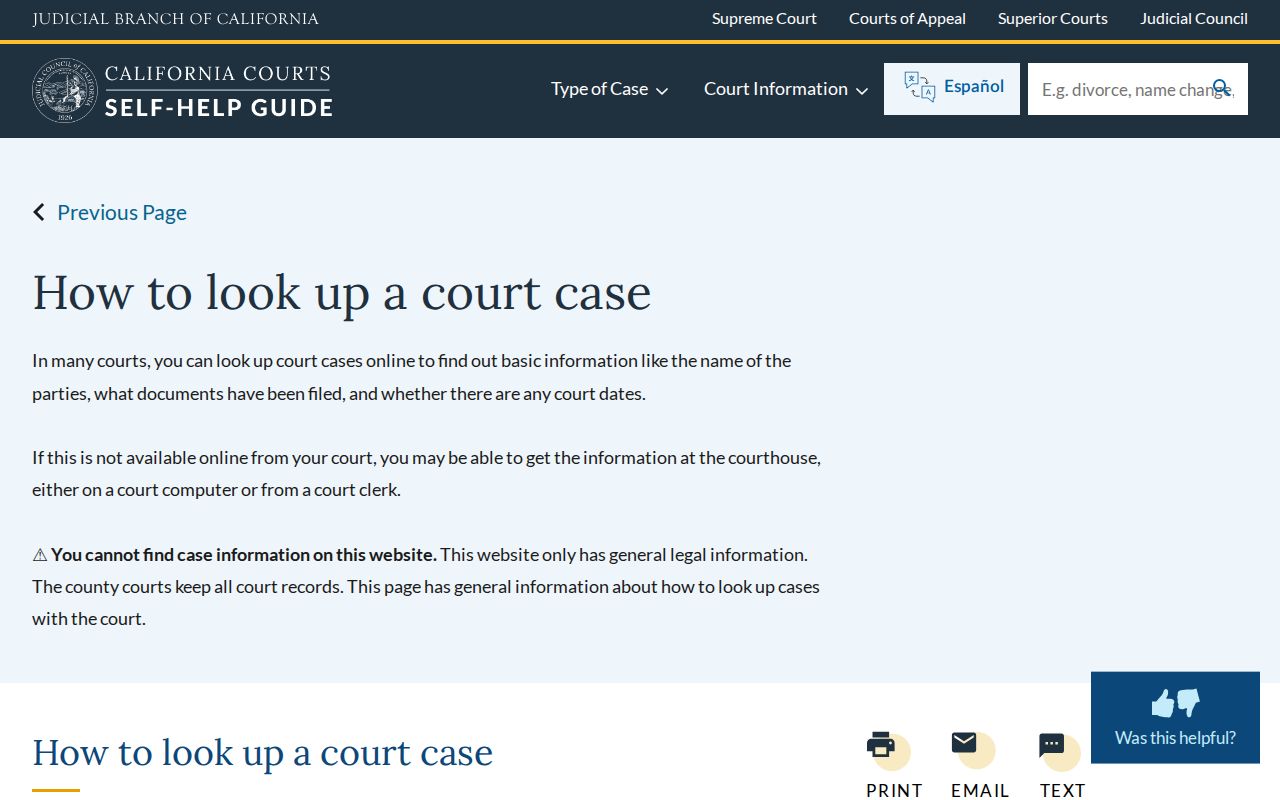
Use the image as a reminder to record the source and access limit beside each match. A result that cannot be checked against the custodian remains a lead.
- Docket
- The court's running case record, including parties, filings, events, and status entries.
- Index versus image
- An index points to a record and may show a few fields; an image is the scanned or filed document, when public and available.
- Certified copy
- A custodian-issued copy with a certification that adds formal assurance about the copy's source and status.
Vital Records for a Lodi Resident Lookup
California vital records have a custody split. The San Joaquin County local registrar handles current and prior-year births and deaths. The County Recorder holds all years of county birth and death records and public marriages. The County Clerk holds confidential marriage records. The Superior Court alone certifies divorce decrees, while CDPH issues statewide certificates and a certificate of record for divorce rather than the full decree. The state’s custodian guide helps separate the local registrar, county recorder/clerk, and court roles. Choosing the right custodian prevents a search from being mistaken for a missing event.
California distinguishes authorized copies from informational copies. An informational copy is marked not valid to establish identity. An authorized birth, death, or marriage copy requires a qualifying relationship or role and a sworn statement, with a mailed sworn statement notarized. Applications identify the applicant, record type, copies, event date and place, names including birth names, parents where relevant, relationship or purpose, signature, and certificate type. The direct forms are VS 111 for birth, VS 112 for death, VS 113A for marriage, and VS 113B for divorce.
Confidential marriage copies are limited to the parties or a court order. Adoption files are sealed under Family Code section 9200 and following. An adoption or birth-parent question therefore uses official court-petition and adoption-information or reunion routes, not an ordinary public name lookup.
2026 timing and fees. The CDPH fee schedule lists $31 for birth, $26 for death, $19 for marriage, $18 for a dissolution certificate, $23 for fetal death, and $28 for stillbirth. No-record results produce a Certificate of No Public Record while retaining the search fee. Use a check or money order, not cash. Beginning July 1, 2026, direct CDPH forms replaced third-party online-vendor submission. CDPH also began accepting certain diacritical-mark amendments under AB 64; that amendment fee is $26 including one certified copy.
Lodi Heirs, Classmates, and Birth-Parent Paths
A useful resident lookup follows the record type that can answer the human question. An heir search starts with the probate docket and public filings, then tests a deed transfer and corroborates death evidence. It does not establish legal heirship by itself. An obituary can supply a relative, former address, or organization, but it should be checked against a vital or probate record.
For a former classmate, start with Lodi Public Library resources such as yearbooks, local newspapers, obituary access, vertical files, and licensed genealogy databases. The Lodi Public Library can help identify the right local-history source and its current access conditions. For a birth parent, California's sealed adoption-information and reunion processes are the lawful route. Recent sacramental or school records may have separate privacy rules.
- Estate or heir question: probate filings, deed transfer, death record, obituary, and later court orders.
- Former classmate: yearbook, alumni material, newspaper, organization archive, and a current public professional or business listing.
- Birth-parent question: official adoption-information and reunion process, with no assumption that a public birth index can answer it.
- Military or community reconnection: library, museum, newspaper, club, and congregation records where the holder permits access.
Note: A newspaper clue can point to a person or place, but a custodian record should carry the final factual weight.
Lodi Resident Lookup Business Clues
State filings can separate a person from a same-name result without claiming that a business address is a home. California Secretary of State Business Search accepts an entity number or entity name through Keyword, Exact, or Begins With modes, with entity type and status filters. Corporation numbers use a C plus seven digits; LLC and LP numbers use 12 digits. A free abstract may show entity status, jurisdiction, addresses, agent information, and imaged Statements of Information when available. The official business search is strongest when paired with a date or entity role.
California Department of Consumer Affairs searches can use board or license type, license number, first or last name, business name, city, and county. Results commonly show status, issue and expiration details, an address of record, and discipline links. That address is a professional contact point. It is not proof of residence. In a wine and agriculture center such as Lodi, a winery entity, fictitious business name, licensee, registered agent, and parcel owner may be different people.
Unclaimed Property is a separate, free name clue. Last or Business Name or Property ID is required. First Name, City, and ZIP are optional refinements. Exact matches appear first, followed by similar names. A result tied to Lodi, 95240, or 95242 can support an older city association, but it does not prove current residence. Search the California Controller's claim tool directly and do not pay an upfront locator for a free state search.
| Portal | Useful fields | What the result can and cannot prove |
|---|---|---|
| Business Search | Entity number; Keyword, Exact, or Begins With; type and status | Entity affiliation and filing address, not a household |
| DCA Search | Board, license type or number, name, city, county | License status and address of record, not residence |
| Unclaimed Property | Last or business name, property ID, optional first name, city, ZIP | Historic name and place clue, not present residency |
| Voter status | Voter's own identifying details and registration prompts | Self-record verification only |
Lodi Resident Lookup Privacy Boundaries
California's voter status service is for a voter checking the voter's own record. It is not a public neighbor directory. A full voter file requires a signed application, current photo identification, a qualifying election, scholarly, journalistic, political, governmental, or record-review purpose, and a security plan. San Joaquin County accepts requests in person or by mail, not by email or fax. The application can cover up to 10 specific voters. Review takes 7 to 14 business days; a countywide file is $68, and an approved delivery may use encrypted WinZip email or FTP.
Approved voter data can include name, county, residence and mailing address, party, status, registration date and method, precinct, districts, and participation history by election, date, and method. It never releases a driver's license number, Social Security number, or signature. Personal or commercial use, harassment, unauthorized transfer, and sending the data outside the United States are prohibited. Elections Code sections 2188 and 2194 and 2 CCR sections 19001 through 19013 control the access rules.
Safe at Home adds another boundary. The California program can provide a substitute mailing address, confidential voter registration, protected name-change processes, and DMV suppression for qualifying survivors. Government agencies and California courts must accept the designated address, and Government Code section 6209.5 permits substitution on specified real-property documents. It does not erase old public records. A Safe at Home explanation helps distinguish a protected address from a bad search result.
Covered businesses and registered data brokers may offer know, delete, correct, and opt-out requests under California privacy law and the Delete Act's DROP platform. Identify the compiler showing a record, submit its privacy request, save the confirmation, and check again later. An opt-out changes that copy of the information. It does not remove the county deed, court file, or vital record held by the source custodian.
Lawful personal use. A Lodi resident lookup is for personal, lawful research, family history, reconnecting, estate work, or record verification. Do not use records to stalk, harass, intimidate, or harm anyone.
Correct the Custodian's Record First
When a result is wrong, contact the office that created or holds it. The Assessor handles roll data. The Recorder preserves a recorded instrument and usually needs a corrective document rather than a simple deletion. Court corrections or sealing follow court process. Voter corrections go to elections. Vital-record amendments use the responsible registrar or CDPH form. A commercial compiler needs a separate opt-out or correction request, and changing that copy does not rewrite the source.
For an identifiable Lodi administrative record, California's Public Records Act, Government Code section 7920.000 and following, is the request path. An agency normally determines disclosure within 10 days, with up to 14 extra days for unusual circumstances. It may charge statutory direct duplication costs, not general search or review labor, unless another statute applies. Court case files follow court rules instead of ordinary CPRA. Give the custodian a record type, date range, department, address or parcel number, and known name rather than asking an office to create a new directory.
Note: A correction request is strongest when it names the record, cites the exact field, and preserves the office's response.